
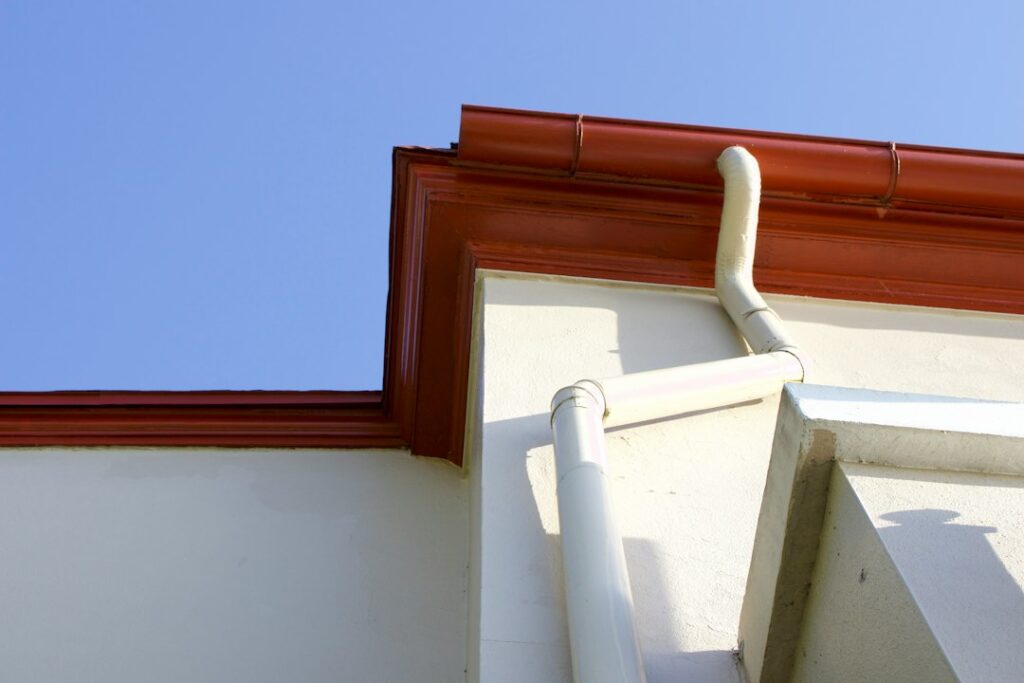
Good roof drainage does more than move water away from shingles. It protects fascia, siding, windows, soil, foundations, walkways, and landscaping from repeated saturation. In Sodus, NY, a drainage system must handle heavy rain, spring snowmelt, falling leaves, ice, and freeze-thaw cycles throughout the year.
What does a roof drainage system include?
A roof drainage system includes every feature that collects water, directs it away from the building, and releases it where it will not cause damage.
Common components include:
- Roof slopes that guide water toward the edges
- Gutters or internal roof drains
- Downspouts and conductor heads
- Elbows, outlets, strainers, and cleanouts
- Downspout extensions or underground drainage lines
- Splash blocks, swales, or other ground-level discharge areas
- Flashing around valleys, chimneys, walls, skylights, and roof penetrations
A problem in one part of the system can affect the rest. A clean gutter cannot compensate for a downspout that releases water beside the foundation. Likewise, a properly placed downspout may still fail if the roof edge, valley, or flashing directs water behind it.
How should gutters and downspouts be arranged?
Gutters should have a consistent slope toward downspout outlets, without visible sagging or sections that hold standing water. Long gutter runs may need more than one outlet so water does not travel an excessive distance before leaving the roof edge.
Downspouts should be placed near roof valleys, inside corners, and other areas where runoff naturally concentrates. Large roof sections, steep slopes, and lower roof areas receiving runoff from an upper roof may require additional drainage capacity.
The outlet should not discharge directly against the foundation. Water should be carried far enough away to prevent soil erosion, basement dampness, and repeated wetting of the foundation wall. The exact discharge method depends on lot slope, soil conditions, nearby paved surfaces, and whether water could flow toward another structure.
How often should roof drainage be cleaned?
For many homes, gutters should be checked at least twice a year: once in late spring and again in autumn after most leaves have fallen. Homes beneath mature trees may need more frequent inspection.
Cleaning is also appropriate after:
- Severe wind
- Heavy storms
- Ice accumulation
- Nearby tree work
- Roof repairs or replacement
- A period when water spills over the gutter edge
Leaves and small twigs are not the only concerns. Granules from aging asphalt shingles can collect near outlets, while moss, nests, and compacted organic debris can block narrow sections. Gutter screens may reduce large debris, but they do not eliminate maintenance. Fine seeds, roof granules, and wet organic matter can still collect on or beneath them.
Any inspection involving a ladder should be performed from stable, level ground. Walking on a roof or reaching across a steep slope creates a fall hazard, especially when shingles are wet or covered with frost.
What should homeowners look for during a drainage inspection?
A practical inspection focuses on where water is going, not only whether the gutters appear clean.
Look for:
- Water pouring over the front or back of the gutter
- Gutter sections pulling away from the fascia
- Rusted seams, holes, or loose fasteners
- Downspouts that are dented, disconnected, or blocked
- Water stains on soffits, siding, or exterior walls
- Soil washed away beneath roof edges
- Puddles near the foundation
- Peeling paint or soft wood near fascia and trim
- Ice buildup along roof edges after freezing weather
- Water entering at valleys, wall intersections, or roof penetrations
During rainfall, observe whether water flows smoothly through the system. Overflow at one location may indicate a local blockage, but it can also mean the roof area is sending more water to that section than the gutter or outlet can handle.
How should downspouts discharge water?
Downspouts should release water onto a stable area that slopes away from the building. Splash blocks can help spread the flow, but they should sit firmly and direct water away rather than allowing it to pool beneath the outlet.
Longer extensions may be useful where the foundation is close to the roof edge. Extensions should remain connected during storms and should not discharge across walkways, driveways, neighboring property, or areas where winter water could freeze into a hazardous surface.
Buried downspout lines can be effective, but they require careful design. A buried pipe that lacks adequate slope, has a blocked outlet, or freezes repeatedly may back up water toward the house. Underground outlets should remain accessible for inspection and should not be placed where they create erosion or drainage problems elsewhere on the property.
What is different about roof drainage in Sodus?

Local homes experience a mix of rain, wet snow, ice, and rapid temperature changes. That combination places stress on gutters, fasteners, downspouts, flashing, and roof edges.
Snow and ice can temporarily block normal runoff. During a thaw, melting water may arrive quickly, especially when upper roof areas drain onto lower roofs. Ice can also pull on gutter edges or loosen components if water freezes inside the system.
Seasonal maintenance should account for:
- Late-autumn leaf accumulation
- Winter snow and ice loads
- Spring thaw and saturated soil
- Summer thunderstorms with intense rainfall
- Wind-driven rain near exposed roof edges
- Branches and debris from nearby trees
Drainage concerns can be more noticeable on older homes, additions, garages, porches, and properties with several roof levels. Each roof section should be considered as part of the complete drainage path.
Are roof gutters always required?
Not every building uses conventional exterior gutters, but water still needs a controlled path away from the structure. Some roofs use internal drains, scuppers, chains, gravel areas, grading, or other drainage features.
The appropriate system depends on roof design, slope, building height, local weather, and the surrounding site. On low-slope roofs, drains and overflow provisions are especially important because water may remain on the surface if the primary outlet becomes blocked. Ponding water adds weight and can accelerate deterioration of the roof membrane.
New construction and major alterations must follow the applicable New York State building requirements. Drainage design may also be affected by local site conditions, stormwater rules, and the way water is handled on neighboring properties.
When does a drainage problem require prompt attention?
A drainage issue deserves prompt attention when water is entering the building, the roof is visibly sagging, a gutter is pulling away, or large areas of soil are being washed toward the foundation.
Extra caution is appropriate when there is:
- A ceiling stain that grows during rain
- Water running behind siding or trim
- Repeated basement seepage near one exterior wall
- A blocked internal roof drain
- Extensive ice buildup or an ice dam
- A damaged downspout after a storm
- A roof valley that overflows even when gutters are clear
Roof surfaces, icy edges, and tall ladders can be dangerous. Conditions involving steep roofs, electrical hazards, structural damage, or active interior leaks may require qualified assistance rather than do-it-yourself inspection.
What is the most useful maintenance routine?
A simple routine is usually more effective than waiting for visible damage:
1. Inspect gutters and downspouts in spring.
2. Check the system after major storms.
3. Clear leaves and debris after autumn drop.
4. Confirm that extensions and splash blocks still direct water away.
5. Watch for overflow during rainfall.
6. Check the foundation area for erosion, pooling, or dampness.
7. Inspect roof valleys, flashing, and lower roof sections from a safe location.
8. Address small separations or blockages before winter freezing.
Effective roof drainage is a continuous path: roof surface to gutter or drain, then through the downspout or conductor, and finally away from the building. Keeping that path open and directing water deliberately is the central practice that helps a home manage Sodus’s changing seasons.
